Sharon AI and the neocloud bet: US$2.6bn raised, US$3m of revenue. Who is holding the risk?
Australia's newest AI cloud lost three quarters of its value from the June peak. NEXTDC lost A$3bn in a day. We go through the numbers, the contracts and the power poles, and ask whether investors are making a risky bet.
CISO AI · 27 Oct 2026 · Analysis
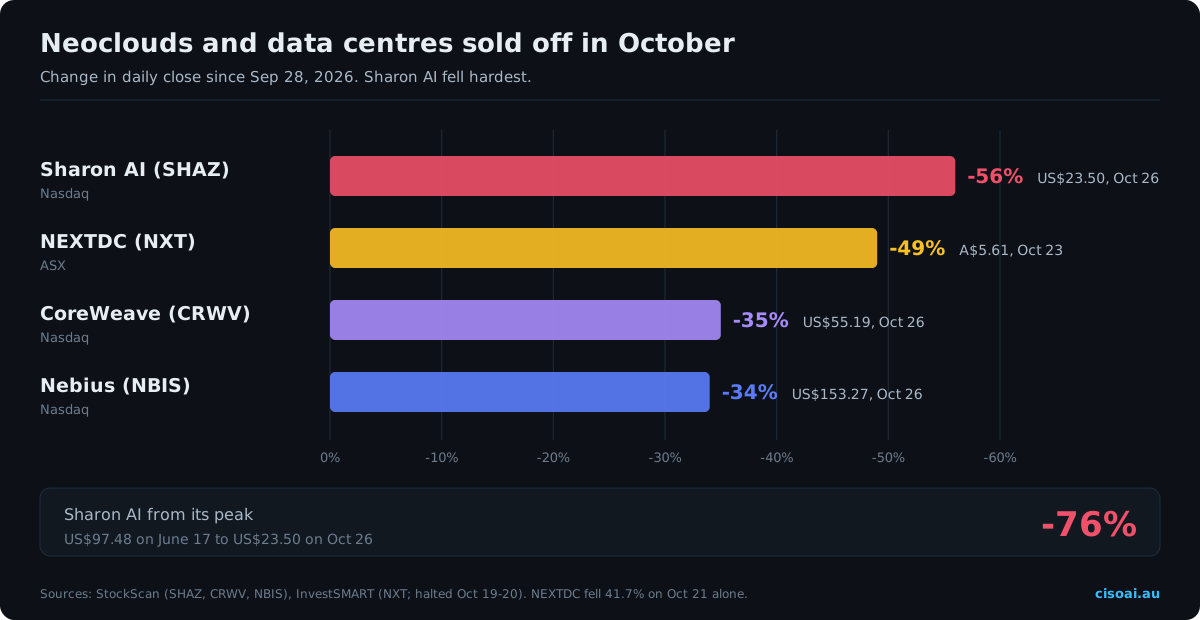
Four weeks ago Sharon AI was the market's favourite way to own a piece of Australia's AI build-out. On October 26 it closed at US$23.50, down 56% since September 28 and 76% below its June peak of US$97.48. In the same weeks NEXTDC lost about A$3bn of value in a single day, and the two big US neoclouds, CoreWeave and Nebius, each fell about a third.
So is this a buying opportunity, or the moment the AI infrastructure trade shows what it really is? We do not give financial advice, and nothing here is a recommendation to buy or sell anything. What we can do is put the numbers in one place, separate what is disclosed from what is assumed, and ask the questions we think investors, lenders and customers should be asking. Then we want your answers. The comments are open at the bottom.
The video above is the 100-second version. Every chart below opens full screen: press Expand or click the chart.
What a neocloud is, and what Sharon AI actually owns
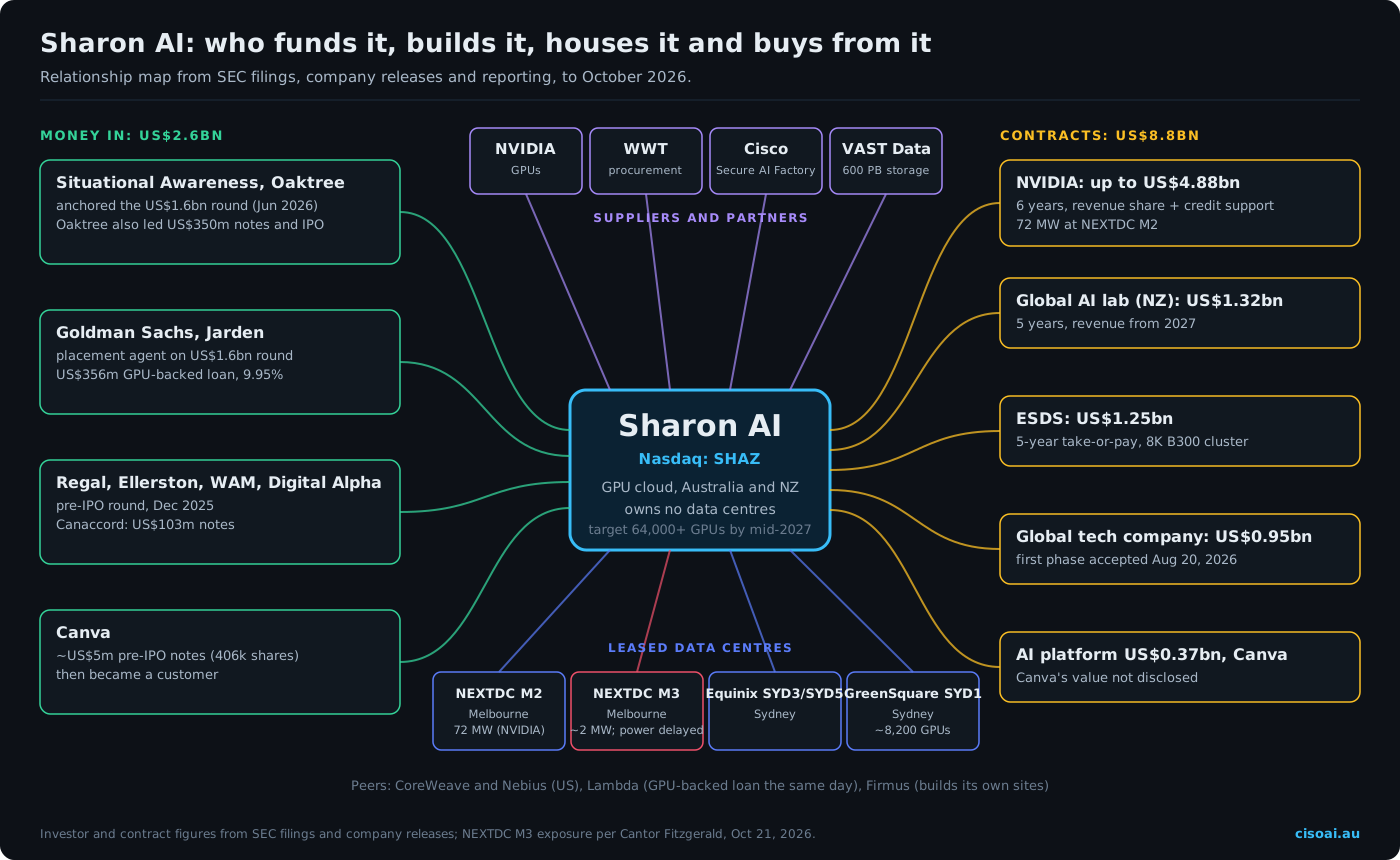
A neocloud is a company that rents out NVIDIA GPUs by the hour or by the contract, mostly to AI labs and large tech firms that cannot get enough capacity from Amazon, Microsoft or Google. CoreWeave and Nebius are the big US names. Sharon AI is the Australian one, listed on Nasdaq as SHAZ, with a secondary ASX listing still planned.
The business model is simple to describe and hard to run. Raise a lot of money, much of it debt. Buy GPUs from NVIDIA. Lease space and power in someone else's data centre. Sign customers to multi-year contracts. Hope the contracts pay for the chips before the chips are out of date.
Sharon owns none of its buildings. It leases space from NEXTDC in Melbourne, Equinix in Sydney and GreenSquare in Sydney, and World Wide Technology (WWT) buys, assembles and installs the NVIDIA hardware. Its plan is more than 64,000 GPUs by mid-2027.
The numbers that matter
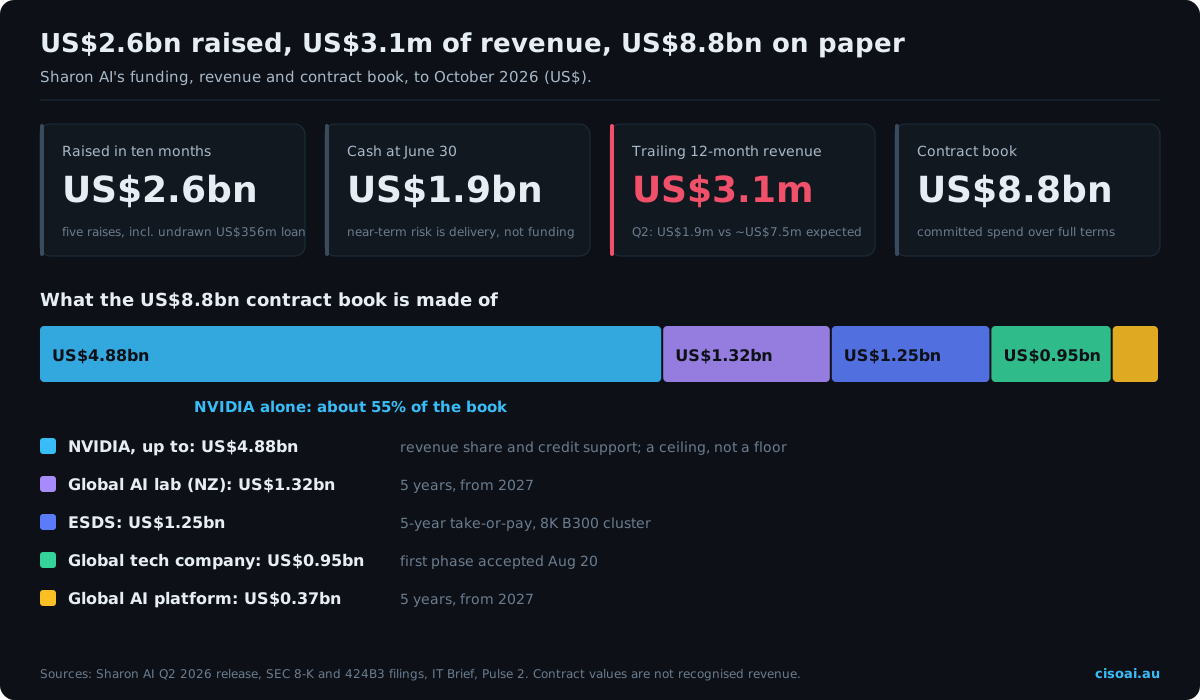
Four figures tell most of the story.
- US$2.6bn raised in ten months. Pre-IPO notes in December 2025, a US$125m IPO, US$350m of 6% convertible notes in May, a US$1.6bn round in June anchored by Situational Awareness and Oaktree, and a US$356m loan secured against the GPUs at 9.95% in October.
- US$1.9bn of cash at June 30. The near-term risk is delivery, not running out of money.
- US$3.1m of revenue in the last twelve months. Q2 2026 revenue was US$1.93m against analyst expectations of about US$7.54m.
- US$8.8bn of contracts. This is committed customer spend over the full term of each contract, not revenue already earned.
Five claims that do not hold up
Much of what circulated about Sharon AI this month came from an AI-generated thread that was widely shared. Most of its headline numbers check out against the filings. These five do not.
| Claim | What the sources show |
|---|---|
| NVIDIA guarantees US$817m a year | The filing says "up to" US$4.88bn over six years under a revenue-sharing and credit-support model. US$817m is that ceiling divided by six. |
| Adjusted EBITDA of US$0.6m shows positive cash flow | It excludes interest, tax, depreciation, stock-based pay and fair-value changes, and says nothing about spending on chips. |
| Canva invested US$23m | Canva's pre-IPO notes converted to about 406,000 shares at US$12.53, roughly US$5.1m. US$23m is what that stake was later worth. |
| Meta and OpenAI buy capacity from Sharon | Every large contract is with an unnamed counterparty. No credible source names either company. |
| Most revenue comes from US data centres | Sharon's own filing says its AI cloud is based in Australia. It sold its stake in a Texas data centre venture for US$70m. |
The thread also left out the two facts that matter most right now: the share price had halved in a month, and revenue was running well behind forecasts.
NEXTDC, the power poles and the real bottleneck
On October 21 NEXTDC told the market that extra grid power for its M3 data centre in Melbourne would be delayed. The network operator Jemena said it could not get on with the work: there were safety concerns, community opposition stopped crews reaching work sites, and council consent had not been given. The upgrade replaces 7-metre wooden poles with 15-metre concrete poles carrying 66 kV. Jemena will not restart before February 2027, and the next supply increase is now expected in FY28.
NEXTDC cut its FY27 EBITDA guidance by about 36%, from A$385-410m to A$245-265m, deferred A$140m of contracted revenue, shelved new projects, cut planned capital spending by A$750m and said it may sell some development land. The shares fell 41.7% that day, the worst day since it listed in 2010.
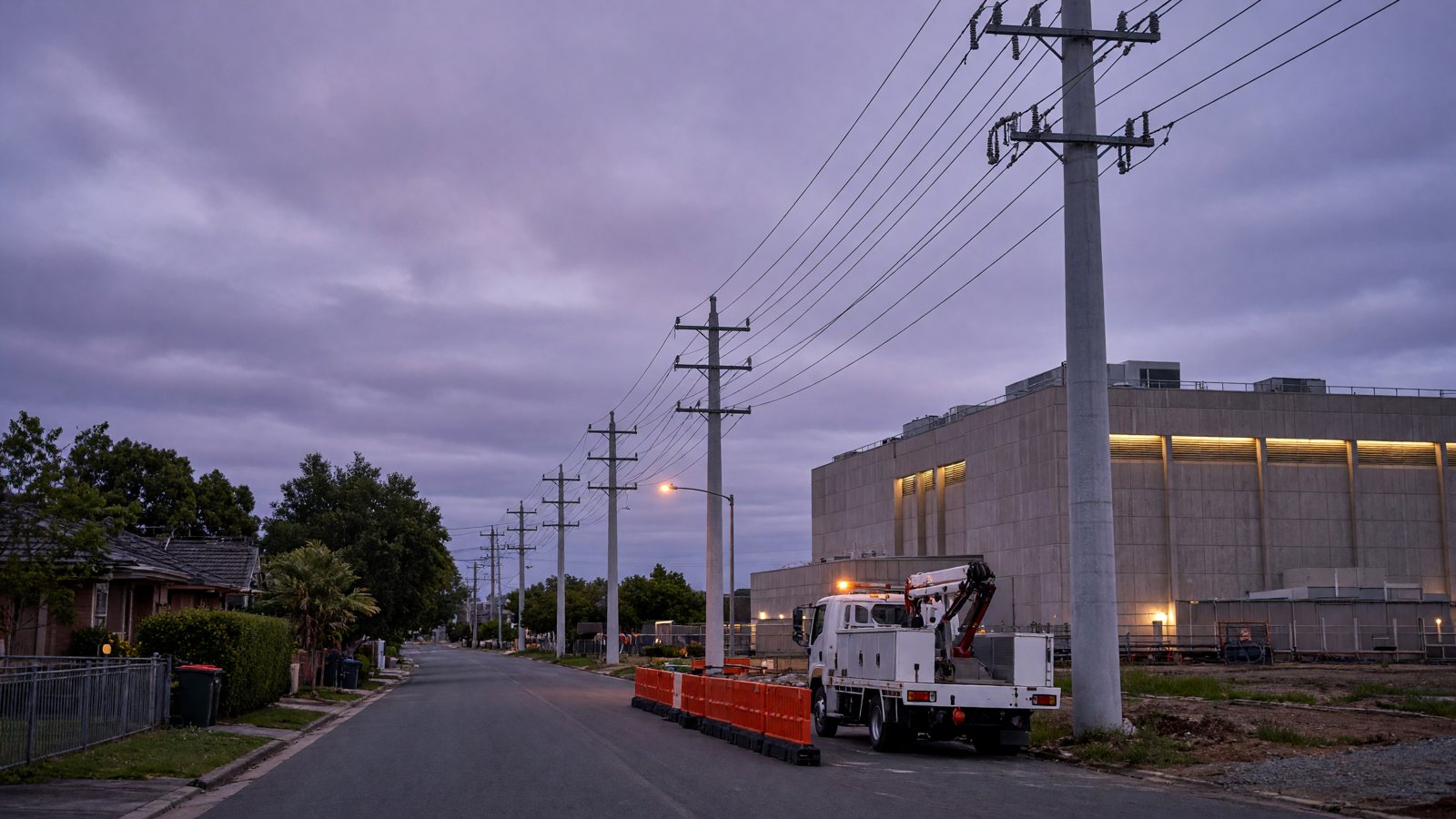
Did the M3 delay hit Sharon? Less than the headlines suggested. Cantor Fitzgerald said on October 21 that Sharon has about 2 MW running at M3 and no other M3 exposure in its contracted pipeline. The 72 MW for the NVIDIA agreement sits at NEXTDC's M2, which reported no delay.
The wider lesson is the one we think matters. The constraint on Australia's AI build-out this year was not chips or money. It was poles, wires, councils and residents. Every neocloud that leases rather than builds is exposed to the slowest part of someone else's supply chain.
When does the money come back?
To answer that, we built a simple scenario model from the disclosed contracts. Each contract's value is spread evenly over its term. The US$2.6bn is depreciated over six years, the life CoreWeave uses for its GPUs, and about US$90m a year of interest is added. Margins are benchmarked to CoreWeave's 59% adjusted EBITDA margin, with 45% as a sensitivity. This is our model, not reported data, and every input is listed at the end.
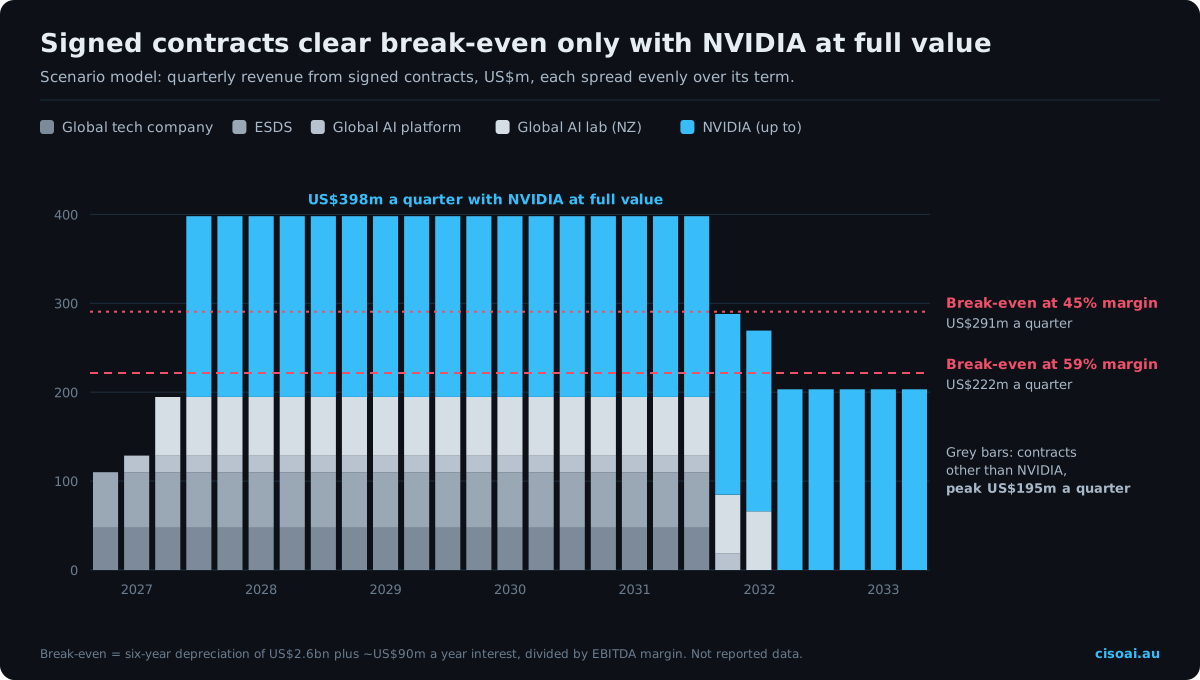
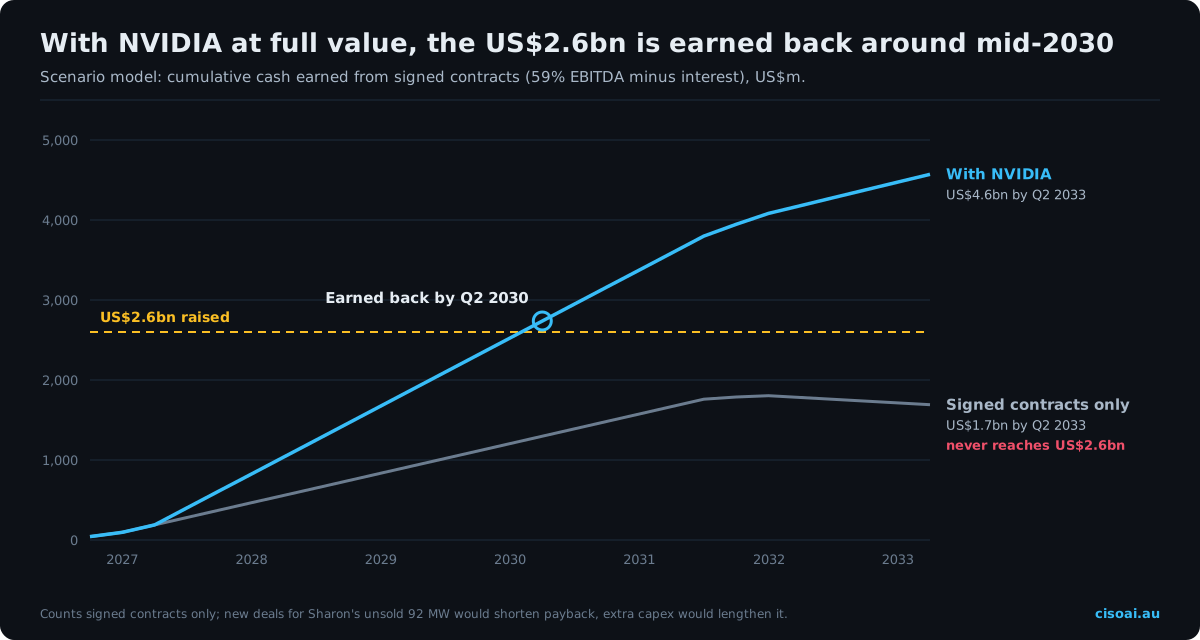
So the whole investment case comes down to one agreement: whether the NVIDIA deal pays anywhere near its ceiling.
Who carries the risk if customers do not come
NVIDIA is paid first. Sharon buys the GPUs with money from investors and lenders, and NVIDIA books that as normal product revenue. The revenue share is upside on top.
NVIDIA's exposure is the credit support in the agreement, and Sharon has not disclosed its size. In NVIDIA's US$6.3bn deal with CoreWeave, NVIDIA must buy any capacity CoreWeave cannot sell, through April 2032. If Sharon's terms are similar, weak demand means NVIDIA pays for idle capacity, up to the ceiling. That is our inference from the CoreWeave deal, not a disclosed term. CoreWeave's agreement can also be ended if either party enters insolvency proceedings that are not resolved within 90 days. If Sharon's terms match, the backstop disappears exactly when it would be needed most.
That leaves two groups holding most of the downside:
- Shareholders, through a falling share price and dilution if Sharon raises more equity to finance the rest of its 64,000 GPUs.
- Lenders, whose security is hardware that loses value every year. If GPUs turn out to last four years rather than six, as some short sellers have argued about the whole sector, the collateral is worth less than the loan books assume.
Why this is a security question, not only an investment one
CISO AI does not usually write about share prices. We are writing about this one because Australian businesses, agencies and AI labs are signing multi-year contracts with GPU clouds, and the financial health of the provider is now part of the risk assessment.
- Supplier failure is a security event. If a provider fails or its GPUs are taken by lenders, where does your data go, who holds the encryption keys, and how fast can you move your models and workloads?
- Concentration. One provider, one data centre operator, one power network. APRA's CPS 230 already asks regulated entities to plan for the failure of a material service provider. GPU capacity is becoming one.
- Sovereignty claims. "Sovereign AI" means little if the capacity depends on a single foreign supplier's revenue-sharing agreement and an undisclosed backstop.
- Due diligence. Ask for the provider's latest cash position, debt maturities, customer concentration and exit terms, and read their filings rather than the summaries.
What would change our view
- Q3 results, due but not yet dated. Revenue from the ESDS contract and the US$950m global tech contract should start to show.
- Disclosure of NVIDIA's credit support. It is the single number that decides whether the "with NVIDIA" line is realistic.
- New signed customers for the 92 MW of unsold capacity, ideally named.
- Delivery on time at M2, Equinix and GreenSquare SYD1, where about 8,200 GPUs are due.
Over to you
We have set out the numbers as fairly as we can. Now we want the argument.
- Is Sharon AI's fall an overreaction to a revenue miss, or a correction of a valuation that never made sense on US$3m of revenue?
- Should a contract that is "up to" US$4.88bn count in a US$8.8bn contract book at all?
- Who should carry more of the risk in these deals: NVIDIA, the lenders or the shareholders?
- Is Australia's real AI bottleneck power and community consent rather than chips and capital? What should change?
- If you buy GPU capacity, what do you now ask a provider about its finances before you sign?
Sign in and leave a comment below. Disagreement is welcome, especially if you have numbers.
Model assumptions
| Input | Value used | Type |
|---|---|---|
| Money to earn back | US$2.6bn, including the US$356m loan as if fully drawn | Disclosed |
| Global tech company contract | US$950m over 5 years, from Q4 2026 | Disclosed |
| ESDS contract | US$1.25bn over 5 years, from Q4 2026 | Disclosed, start date adjusted |
| Global AI platform contract | US$373m over 5 years, from Q1 2027 | Disclosed |
| Global AI lab contract (NZ) | US$1.32bn over 5 years, from Q2 2027 | Disclosed |
| NVIDIA agreement | Up to US$4.88bn over 6 years, from Q3 2027 | Disclosed ceiling, start assumed |
| Revenue timing | Each contract spread evenly over its term | Assumption |
| Canva and new contracts | Not counted | Assumption |
| EBITDA margin | 59%, with 45% as a sensitivity | Benchmark (CoreWeave Q2 2026) |
| Depreciation | US$2.6bn over 6 years | Benchmark (CoreWeave) |
| Interest | About US$90m a year | Disclosed rates on the notes and loan |
| Tax, working capital, debt repayment | Not modelled | Assumption |
This article is general commentary, not financial advice. Share prices are as at the dates shown. The payback figures come from a scenario model, not from Sharon AI's accounts.
Sources
- SEC 8-K: US$1.6bn financing
- SEC 424B3: NVIDIA agreement and revenue-share model
- SEC S-1/A: US$350m notes
- SEC FY2025 annual report
- Sharon AI Q2 2026 results and Q2 earnings call
- US$356m GPU-backed loan
- IT Brief: US$8.8bn contract value
- Forbes Australia: Canva's stake
- Investing.com: Cantor Fitzgerald on M3 exposure
- DealStreetAsia/Reuters: NEXTDC shares fall 42%
- investingLive: NEXTDC guidance cut
- The New Daily: NEXTDC expansion stalls
- Energy Connects/Bloomberg: the power poles
- Capital Brief: M3 power delayed to FY28
- Motley Fool: Michael Burry on GPU depreciation
- CoreWeave Q2 2026 results
- RCR Wireless: NVIDIA's CoreWeave capacity deal and Converge Digest: termination terms
- DCD: GreenSquare SYD1 lease
- StockScan: SHAZ price history and InvestSMART: NXT share price
Comments
No comments yet.